


 Keeping track of dozens of accounts and investment portfolios is difficult. And very few investors understand how global events or financial news affect their finances. We’ve developed an AI assistant designed to improve financial health that combines both: Pulse. Our authors take you through the innovation process and share their key insights.
25.03.2026
08:00 AM
Pulse: Improve Your Financial Health with a Daily AI Briefing
Hyper-personalization supports individual financial well-being
When we talked about the major missed opportunities in banking five to ten years ago, hyper-personalization was often keyword: Just think of all the things you could do with the data generated in the financial sector to offer customers better services and products!
Thanks to artificial intelligence, hyper-personalization is no longer just a vague buzzword used by futurists, but could become an integral part of personal finance—that is, private financial planning. Last month, our colleagues Lily Sondhauß, Luis Dille, and Samuel Speicher presented various future scenarios on this topic , outlining AI first as a tool to help understand personal finances and later as an autonomous partner in personal financial planning.
In this article, we’d like to supplement these hypothetical considerations with a practical example we developed during our innovation process:Pulse, a daily financial briefing for retail customers. To do this, we deconstructed the concept of a human financial advisor and asked ourselves what actually makes the perfect assistant: It would need to monitor our transactions and holdings seamlessly while simultaneously filtering out exactly the news that could impact our assets. In the next step, it could then ideally offer intelligent suggestions based on all this data.
Pulse is our attempt to entrust this very responsible task to an AI. We developed the idea into a proof-of-concept (PoC) at the end of 2025 to demonstrate its feasibility.
A daily briefing on financial well-being
Pulse is modeled after the daily fitness check offered by modern wearables such as Whoop. We asked ourselves: What would a financial briefing look like that offers retail customers a comparable value as a brief conversation with a professional financial advisor?
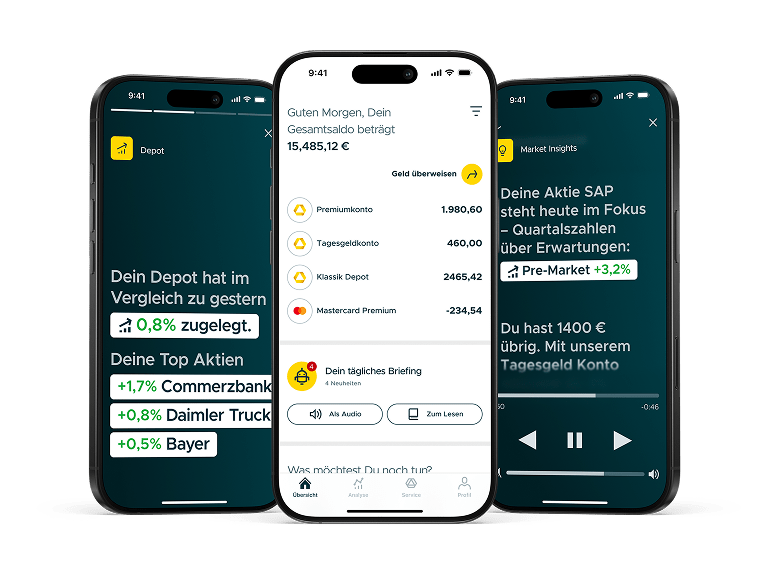
The result is an AI-powered financial assistant that retrieves data from accounts and investment portfolios, automatically categorizes and analyzes expenses, combines this information with news relevant to personal finances, and actively supports users in achieving their personal financial goals. Users no longer have to manually scroll through their accounts or laboriously sift through dry news sites and newsletters to find information relevant to them. Instead, they receive a mini-update once a day in the easy-to-grasp, visually appealing style of an Instagram Story.
Pulse curates the information so that you can read it in just a few minutes or—thanks to the text-to-speech feature—listen to it. The product is designed to be your morning coffee companion: In two minutes, users know everything relevant to their financial day. This can massively reduce the stress that finances often cause. Despite the minimal time investment,Pulse can help contribute to your own financial well-being. Financial well-being includes, among other things, the feeling of having control over daily finances and being on track toward one’s goals (our colleague Luis Dille recently wrote about this definition and other important insights on financial wellness here
With a radical focus and a precise scope
The innovation process—this time in collaboration with data scientists and developers from IBM—consisted of a total of eight sprints, one per week, ranging from scoping to various LLM applications (Large Language Models, the foundation of today’s generative AI) and on to news analysis.
In order to deliver a result like Pulse in just two months, you need a laser-sharp focus and a precisely defined scope. To achieve this, we held a six-hour design thinking workshop with an external expert at the start of the process, during which we clearly defined the vision and the steps needed to make it a reality.
We always came back to the PoC’s primary goal: to demonstrate that the AI-based personal finance assistant we had envisioned in terms of functionality was something that could actually be built. To that end, for example, we deliberately chose not to delve into the technical intricacies of real banking interfaces during the first workshop so that we would have sufficient resources. Also, when selecting news sources, we used a news API and simply used the top news stories for each stock instead of delving deeper into news selection. Both decisions were, you could say, for the greater good of proving this idea was feasible.
More important than the source material were questions such as: How can an LLM filter out precisely those news that are relevant to a specific user’s personal finances from the noise of hundreds of news stories per day? Can modern AI models determine whether a financial news item has a positive or negative impact on a stock if the news item itself does not already provide this classification? And how do you deal with the still very common hallucinations of AI models in such a development process? For example, we have been working intensively on how so-called Guardian models can serve as a control mechanism to ensure that the summaries and figures generated by AI are accurate.
Enormous potential for personal financial health
For us, one of the most important insights from this development is: what was truly innovative about this project wasn’t the implementation of AI features such as text generation or text-to-speech. Those have long since become standard.
No. It was the background classification which was and remains groundbreaking: hyper-personalization means finding the right signal amid the data noise, and this PoC successfully achieved that. Our Pulse team has demonstrated that, thanks to the rapid development of LLMs, many of the tasks of a personal financial assistant can indeed already be implemented responsibly, precisely, and correctly in an AI application.
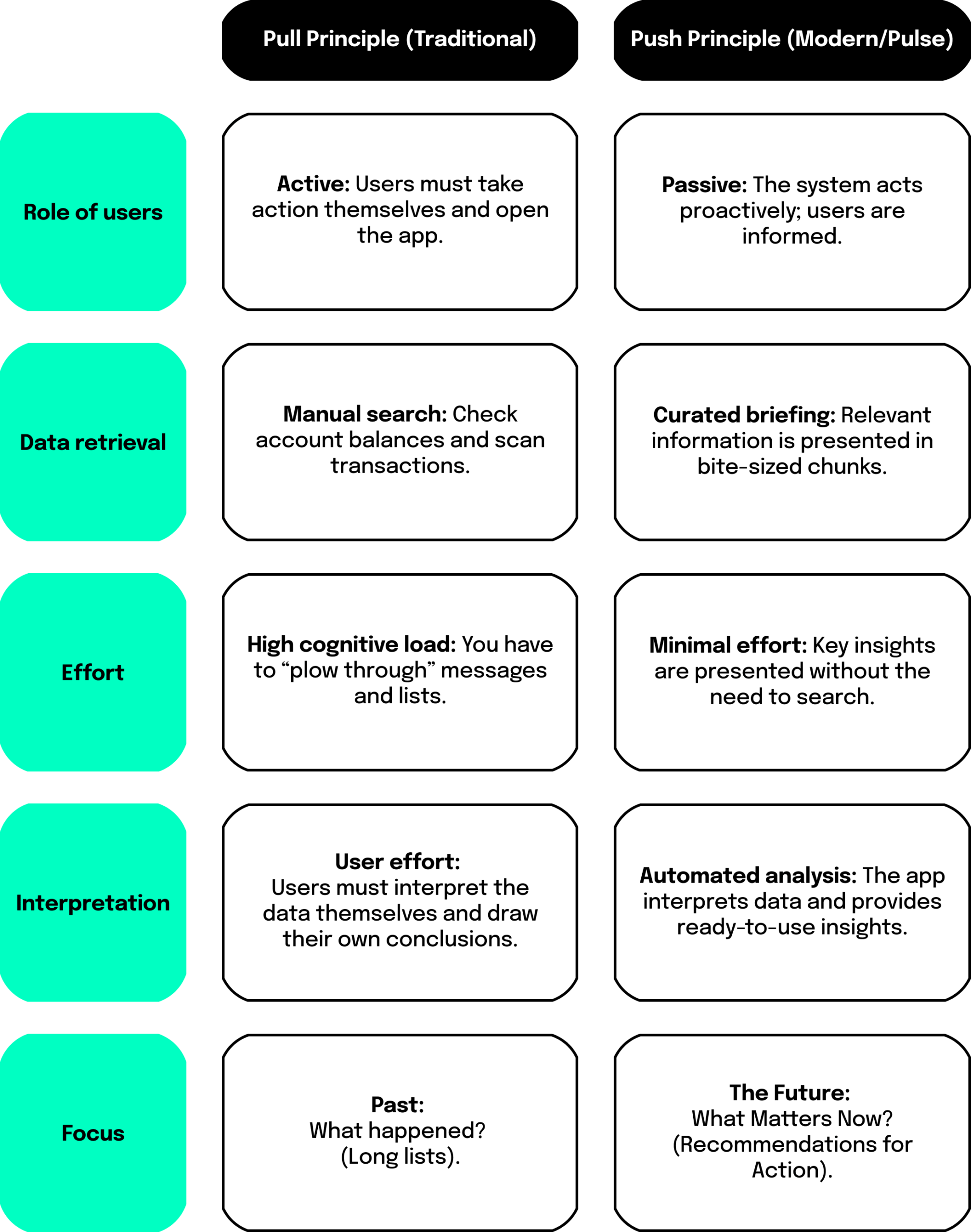
For us, Pulse has demonstrated, beyond fictional future scenarios, the practical possibilities in the field of personal finance: Even today, AI can be used to create a digital experience that comes very close to that of a personal financial advisor.
And even though the PoC process for Pulse has been completed as planned, the project is far more than just a prototype sitting on the shelf. It is a blueprint for the responsible use of artificial intelligence: by employing Guardian models as a supervisory mechanism, we have found a way to minimize the common errors of LLMs and bring reliability to financial analysis. For us, Pulse is the proof: we no longer have to wait for the future—the technological foundation for hyper-personalized financial wellbeing is already here.



Why is our newsletter like a perfect pitch?
Because it’s short, smart, and packed with insights that stick with you.